


 Cart
Cart
 sales@molnova.com


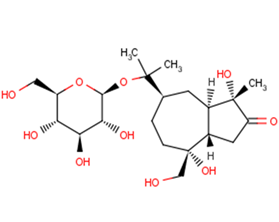
Atractyloside A
CAS No. 126054-77-1
Atractyloside A( —— )
Catalog No. M17916 CAS No. 126054-77-1
Atractyloside is a glycoside of a kaurene type diterpene that is found in some plants including Atractylis gummifera (atractylis); coffee; xanthium, and callilepis.
Purity : >98% (HPLC)
 COA
Datasheet
HNMR
HPLC
MSDS
Handing Instructions
COA
Datasheet
HNMR
HPLC
MSDS
Handing Instructions
| Size | Price / USD | Stock | Quantity |
| 5MG | 87 | In Stock |


|
| 10MG | 132 | In Stock |
|
| 25MG | 264 | In Stock |
|
| 50MG | 492 | In Stock |
|
| 100MG | 701 | In Stock |
|
| 200MG | Get Quote | In Stock |
|
| 500MG | Get Quote | In Stock |
|
| 1G | Get Quote | In Stock |
|
Biological Information
-
Product NameAtractyloside A
-
NoteResearch use only, not for human use.
-
Brief DescriptionAtractyloside is a glycoside of a kaurene type diterpene that is found in some plants including Atractylis gummifera (atractylis); coffee; xanthium, and callilepis.
-
DescriptionAtractyloside is a glycoside of a kaurene type diterpene that is found in some plants including Atractylis gummifera (atractylis); coffee; xanthium, and callilepis. Toxicity is due to inhibition of adenine nucleotide translocase.
-
In Vitro——
-
In Vivo——
-
Synonyms——
-
PathwayOthers
-
TargetOther Targets
-
Recptoradenine nucleotide translocase
-
Research AreaOthers-Field
-
Indication——
Chemical Information
-
CAS Number126054-77-1
-
Formula Weight448.5
-
Molecular FormulaC21H36O10
-
Purity>98% (HPLC)
-
SolubilityDMSO : ≥ 30 mg/mL; 66.89 mM
-
SMILESC[C@@]1([C@@H]2C[C@@H](CC[C@@]([C@H]2CC1=O)(CO)O)C(C)(C)O[C@H]1[C@@H]([C@H]([C@@H]([C@H](O1)CO)O)O)O)O
-
Chemical Name——
Shipping & Storage Information
-
Storage(-20℃)
-
ShippingWith Ice Pack
-
Stability≥ 2 years
Reference
1. Todisco S, et al. Biochem Pharmacol. 2016 Jan 15;100:112-32.
molnova catalog



related products
-
CP 376395
CP 376395 is an effective and specific Corticotropin-releasing factor 1 (CRF1) receptor antagonist.
-
ZZL-7
ZZL-7 is a fast-onset antidepressant agent that disrupts the interaction between neuronal nitric oxide synthase (nNOS) and the serotonin transporter (SERT) in the dorsal raphe nucleus (DRN).
-
LMP2 (236 - 244) , R...
LMP2 (236 - 244) , RRR
